Showing posts with label indiana waterproofing. Show all posts
Showing posts with label indiana waterproofing. Show all posts
Sunday, December 27, 2015
Basement Waterproofing Contractors Indianapolis
Basement waterproofing is usually not a high concern for most Indiana homeowners during the winter months. But this winter is just a bit different. Indiana homeowners have seen much higher than normal rainfall in the past few weeks, with really no end in site. This has started to cause some basements in Indiana to experience water problems that are usually seen during the spring and summer months. Basement water problems can be a real headache for Indiana homeowners, especially if your basement is used as a livable space. Searching for an honest, trustworthy basement waterproofing contractor in Indiana can also be a headache for homeowners. At SwainCo. Crawl Space and Basement Repair we pride ourselves on being one of Indiana's most trusted waterproofing contractors. We are considered by many to be Indy's original experts in this industry. At SwainCo. we have the experience and knowledge to permanently fix your basement water problems once and for all. If you have a wet basement or have basement water problems, call SwainCo. today at 317-407-1868 or click here to visit us online for a FREE basement evaluation.


Tuesday, February 11, 2014
Basement Waterproofing in Indianapolis
Indianapolis homeowners with basements know all too well the water problems that can be associated with having a basement. A few weeks ago we did a free inspection for an Indianapolis homeowner who was having wet basement problems. He informed us that he had a drainage system installed many years ago and did not think it was working anymore. During the free inspection we noticed that indeed he did have a very old drainage system installed some time ago. The type of existing basement drainage system he had consisted of a solid 2" perforated PVC pipe installed below the slab around the entire foundation, connecting to a pit and sump pump basin. This system also had some type of FRP panel installed on the foundation wall up approx. 2' from the slab floor. This was done to cover the weep holes that were drilled above the slab and direct the water to the drainage system. The problem with this type of system, other than the age, was:
 1. The 2" PVC drainage pipe had perforated holes that were too big. This, along with minimal gravel back fill allowed dirt, silt, and gravel to enter the drainage system and severely restrict any water flow to the pit and pump.
2. The weep holes were drilled above slab and covered with a thin FRP type panel. Over time this panel had cracked, broken and for the most part was no longer present in much of the basement. This allowed water from the weep holes to drain directly on the slab. This type of panel does not allow for very good water flow behind it. So in areas that the panel was present, water from the weep holes would flow over the top and onto the slab the floor.
We recommended upgrading his drainage system to a permanent, lifetime warranty SwainCo. Dry Basement Drainage System. This consisted of breaking out the concrete around the entire of the foundation walls were his existing system was. Once that was done, we proceeded to remove all parts of his older, no functioning drainage system. In the same trench that his original basement drainage system was, we installed a 3" perforated flex drainage tile. We then connected this tile to his existing pit basin, which we saw no need to replace. This type of drainage tile has slits instead of holes which, along with the proper gravel back-fill that we installed, reduces the chance of any unwanted material from entering the drainage system. We then installed a black L channel dimple backing board to extend above the existing weeps holes and down across the drainage system. This dimple backing board allows for a much greater ease of water flow from the weep holes to the basement drainage system. This also allows water from any future cracks or leaks above the dimple backing board to drain down the wall behind it, and into the basement drainage system. Lastly, we upgraded his old sump pump to a Zoeller M53 series sump pump.
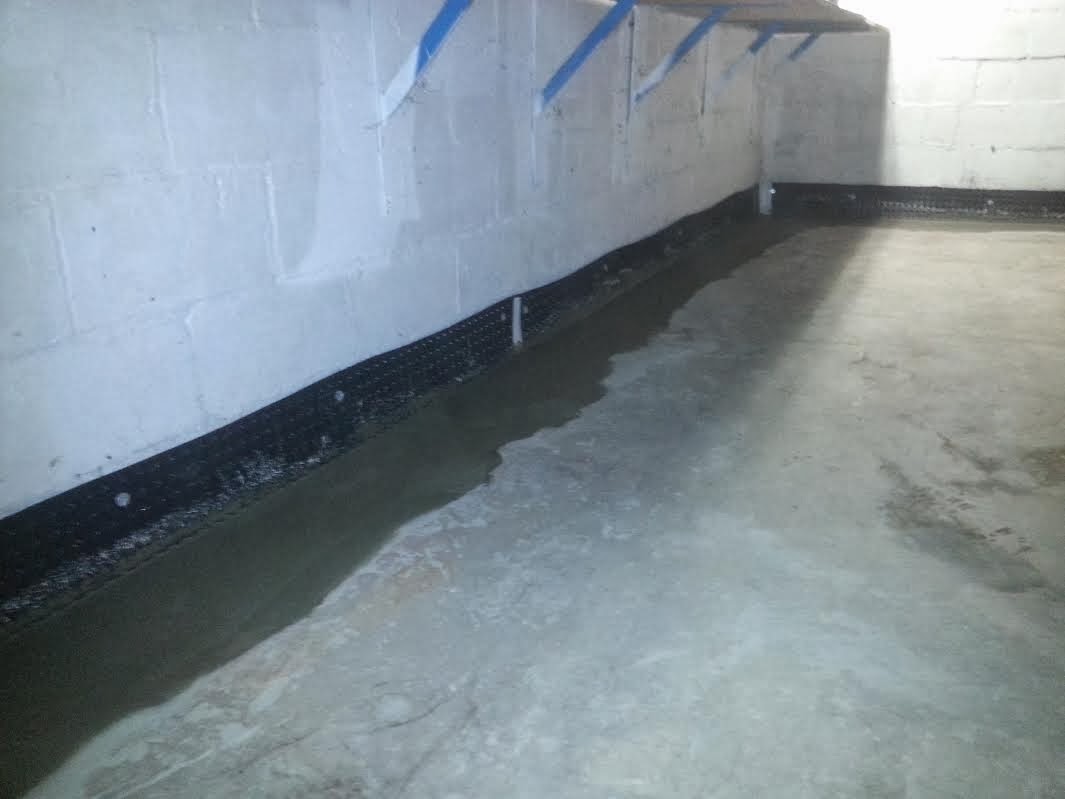 A couple days after the completion of our SwainCo. Dry Basement Drainage System, temperatures rose enough to start melting all the snow. Because of the upgraded drainage system, this homeowner was happy to inform us that his basement stayed 100% dry.
If you have a wet basement problems or need to upgrade your older basement drainage system to a permanent, lifetime warranty SwainCo. Dry Basement Drainage System call 317-294-5278 or click here for a free basement drainage inspection. You can also visit www.swaincollc.com for more information.
2. The weep holes were drilled above slab and covered with a thin FRP type panel. Over time this panel had cracked, broken and for the most part was no longer present in much of the basement. This allowed water from the weep holes to drain directly on the slab. This type of panel does not allow for very good water flow behind it. So in areas that the panel was present, water from the weep holes would flow over the top and onto the slab the floor.
We recommended upgrading his drainage system to a permanent, lifetime warranty SwainCo. Dry Basement Drainage System. This consisted of breaking out the concrete around the entire of the foundation walls were his existing system was. Once that was done, we proceeded to remove all parts of his older, no functioning drainage system. In the same trench that his original basement drainage system was, we installed a 3" perforated flex drainage tile. We then connected this tile to his existing pit basin, which we saw no need to replace. This type of drainage tile has slits instead of holes which, along with the proper gravel back-fill that we installed, reduces the chance of any unwanted material from entering the drainage system. We then installed a black L channel dimple backing board to extend above the existing weeps holes and down across the drainage system. This dimple backing board allows for a much greater ease of water flow from the weep holes to the basement drainage system. This also allows water from any future cracks or leaks above the dimple backing board to drain down the wall behind it, and into the basement drainage system. Lastly, we upgraded his old sump pump to a Zoeller M53 series sump pump.
If you have a wet basement problems or need to upgrade your older basement drainage system to a permanent, lifetime warranty SwainCo. Dry Basement Drainage System call 317-294-5278 or click here for a free basement drainage inspection. You can also visit www.swaincollc.com for more information.
Saturday, November 30, 2013
Crawl Space Sump Pumps
Many home owners with crawl spaces under their home who discover they get standing water in their crawl space after a heavy to moderate rain realize they must do something. Too often they make a decision to install just a sump pump and instantly they have a false sense of security. Yes it is true if your crawl space gets a foot of water at times a sump pump will prevent the crawl space from holding that much water as long as the pump works. Although a sump pump will lower the amount of water in the crawl space, what have you really accomplished? Let’s face it most sump pumps are installed close to the crawl space entry for maintenance purposes. So when the home owner opens the crawl space entry and sees 1-2 inches of water in places instead of a foot of water throughout the crawl space and sees the pump working they feel better. In truth a very damp crawl space is the same as a crawl space with a foot of standing water. They both produce 100% moisture in the crawl space air. This will then increase the moisture levels in the structural wood and will create an environment in the crawl space for wood destroying fungi growth and increased potential for mold growth in the living area above the crawl space. It is not the physical water that is doing the damage, but rather it is the amount of moisture in the air that is doing the damage. A very damp crawl space is the same as having a foot of water throughout the crawl space. If all the gutters are clean and the down spouts are draining away from the house properly with proper grade around the foundation and the crawl space still has standing water after a rain, the crawl space is most likely affected by a high water table. The only remedy in this case is a crawlspace drainage system. For best results the crawl space should also be encapsulated. Don’t be fooled by the Sump Pump only FALSE Sense of security. If you think you might need a drainage system, call 317-828-7897 for a free inspection or visit www.swaincollc.com
Thursday, February 2, 2012
DownSpout Extensions-Why and How
For many Indiana homeowners, extending your downspouts away from your home can have many benefits. Especially when installed correctly. One benefit of extending your downspouts away from your home is that it will greatly reduces your chance for potential foundation issues down the road. When downspouts are not extended the water is dumping usually right next to your foundation. This excess amount of water will expand, and erode soil around your foundation, which in return can cause structure foundation issues such as settling. Extending the downspouts can also help cut down on the amount of water or moisture that gets into your crawl space. As mentioned before, when not extended, downspouts allow large amounts of water to be dumped next to your homes foundation. This water can also tend to seep thru the foundation and into the crawl space. To give you an idea of the amount of water your downspouts can produce consider this. One inch of rain on a 1200 sq.ft. home produces about 750 gallons of water. That is a lot of water to be dumping right next to your homes foundation. Also you want to be sure that the downspout extensions your installing are done correctly. A few things to stay from when installing downspout extensions. First thing I would recommend would be to always use a solid form of pipe or tile to extend your downspouts, whether you extend them underground or above. I have seen many houses who have downspout extensions running into a perforated pipe or tile. This still allows the water to seep out next to the foundation. A solid pipe or tile will prevent this seepage from happening. Be sure to extend them far enough away so that the water isn't making its way back toward your foundation. As far as what type of solid pipe or tile to use really depends on your preference. I typically would recommend a solid 4" PVC type of pipe, such as a schedule 40. I recommend this because this type of downspout extension has a few more benefits than other forms of solid pipe, such as flex tile. Downspout extensions can tend to get clogged with roof debris and leaves. With a solid PVC type of downspout extension, they can easily be snaked to relive any type of clog. This is much harder with a solid flex tile. Also, if your downspout extension is going to be installed underground in an area where heavy equipment or cars may be crossing over, a solid PVC type of downspout extension proves to be much stronger as well. To find out more information on downspout extensions and other crawl space issues visit www.swaincollc.com
Wednesday, November 18, 2009
No Mold is Good Mold
A question I seem to get asked often when noticing signs of mold growth in a homeowners crawlspace is whether or not this mold is bad mold, or harmful mold. For this question to be answered one would have to know what type of mold it is. There happen to be estimates that range from thousands of different types of mold to hundreds of thousands of different types. So to be sure on the exact type of mold a homeowner has or even if it is mold, one would need to have it sent off and tested by mold growth experts to determine the type of mold it is. Without going through the headache and exspense of testing mold, perhaps a better answer would be to just simply eliminate any mold growth in a crawlspace best as possible. And of the most effective ways of doing this is to take away one of the things mold needs to survive, MOISTURE. Although their are all kinds of mold sprays or paints that are designed to stop current mold growth, they don't address the cause of mold growth. Meaning a homeowner has to continuously spray every so often to insure that they have no active mold. But if the cause of the mold growth reduced or even eliminated this could save a homeowner hundreds of dollars in the long run by not having to spray the mold so often, hiring a company every other year to do this. A homeowner may also save money by preventing damage to structure components of their home that can be caused by mold growth. But even better is the fact that a homeowner can have a better piece of mind knowing that the upstairs environment is now a healthier environment to live in when there isn't the presence of mold in a crawlspace. In the long run, preventing or stopping moisture issues in a crawlspace, out way the benefits of many other methods that deal with stopping mold growth. To find out more visit www.swaincollc.com or call 317-828-7897
Thanks,
Indiana Crawlspace Waterproofer
Thanks,
Indiana Crawlspace Waterproofer
Wednesday, October 28, 2009
Two Great Ways to Help Keep Water Away From Your Homes Foundation
The following are three great ways to help homeowners keep water away from their homes foundation. Which in return will aid in keeping your crawlspace or basement dry and your foundation from potential settling issues.
1. Keep Gutters Clean
On a 1200 sq.ft. home, the roof alone produces about 750 gallons of water per 1 inch of rain. That is a lot of water for any gutter system to handle. So when a gutter system starts to get clogged with leaves, branches, etc.. the runoff water from the roof has no where to go but over the sides of the gutter, falling to the ground next to your homes foundation. This can cause large amounts of excessive water to run down the backside of your homes foundation, seeping into the blocks, or cracks, or possible overloading an existing drainage system that was not designed for so much water capacity. To insure this doesn't happen to you, periodically check your gutter system for any debris.
2. Extend All Downspouts
Using the above statistics on gallons of water per inch of rain your roof can produces, you can imagine the amount of water that runs through your downspouts. Homes that have downspouts dumping right next to the foundation are at risk for not only unwanted water penetration into their basements or crawlspaces, but also potential settling issues. Extending downspouts away from your homes foundation can in some cases dramatically drop the amount of water penetration into your basement or crawlspace and aid in the prevention of future settling issues. Their are many methods a homeowner can consider when deciding on how best to extend ones downspout. In my opinion the most effective method would be to run your downspouts into a solid PVC line installed 4"-6" under ground. This PVC line would run out 10'-12' into a bubble or small dry well of some sort. This would accomplish the goal of keeping water away from the house and at the same time eliminate the headache of having to move your extension for various reasons, such as mowing the yard. I prefer PVC instead of the standard black flex tile because if by chance leaves and debris block the downspout extension, PVC lines are proven much easier to snake out than it's black flex tile friend.
Till Next Time,
Indiana Crawlspace Waterproofer
For more information and great waterproofing ideas and solutions, visit www.swaincollc.com or call 317-828-7897
Subscribe to:
Posts (Atom)